"Deciphering the anthropogenic thermodynamic signatures etched into the urban canopy through high-resolution spatial remote sensing and microclimate modeling."
I am Dikshika, a PhD researcher in Atmospheric and Ocean Sciences at the Indian Institute of Technology (IIT) Bhubaneswar, working in the Geo-Marine & Geomatics Research Laboratory (GMAG). My research focuses on Urban Remote Sensing and Surface Energy Balance modelling. I study how cities and concrete infrastructure alter local weather and atmospheric conditions. My doctoral thesis focuses on measuring how urban surfaces absorb and release energy and building models to predict urban microclimates. By analyzing satellite data, I aim to understand how rapid urban growth impacts local climate and turn satellite observations into actionable environmental insights.

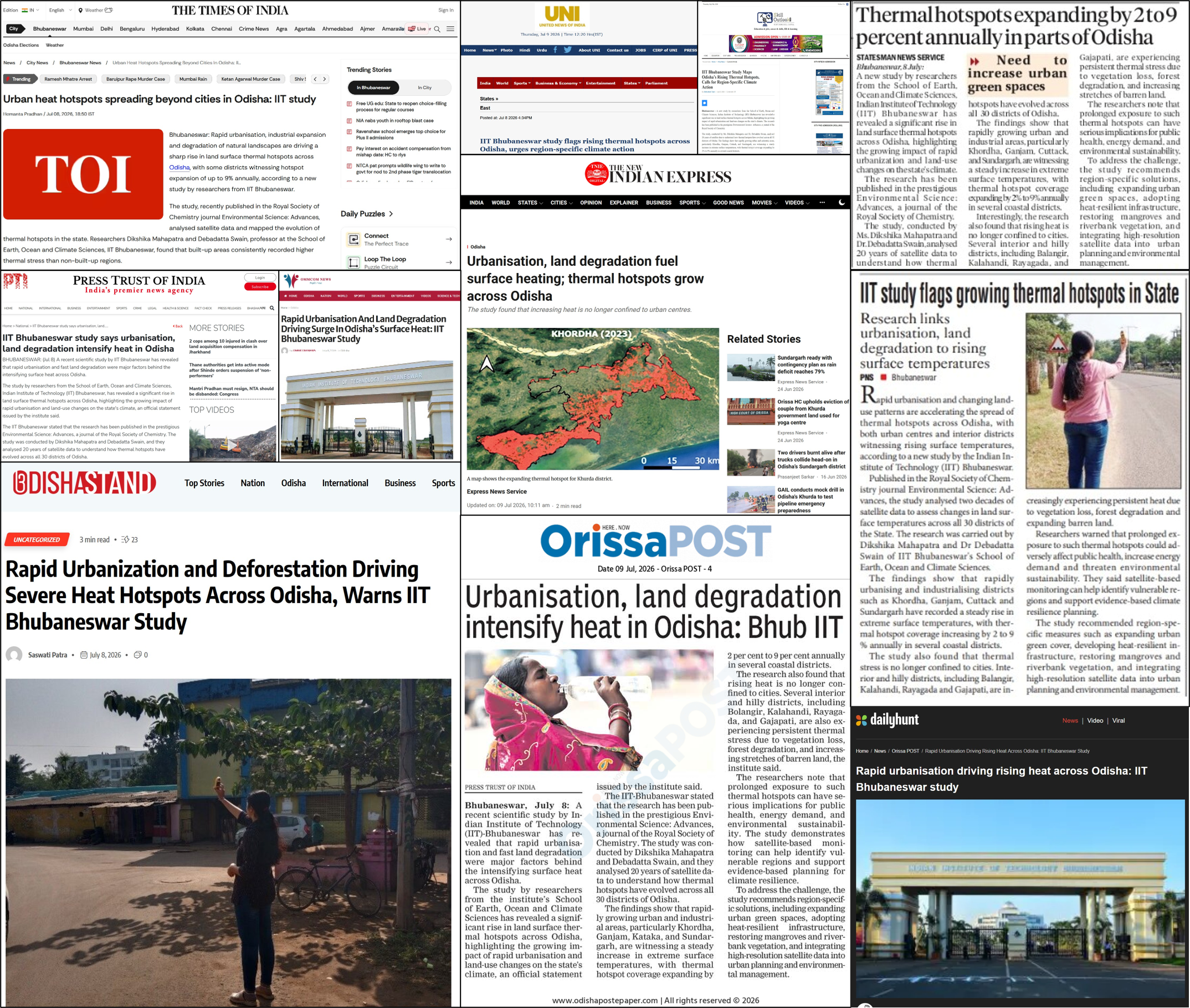
A focal point of my ongoing research work involves the high-resolution geospatial isolation and thermodynamic profiling of urban thermal hotspots. By synthesizing multi-spectral satellite thermography with localized meteorological and structural datasets, this specialized research delineates the precise micro-architectural and anthropogenic drivers that disproportionately exacerbate localized heat stress within urban canopies. The critical socio-environmental implications of these findings, specifically pertaining to heat-induced mortality vulnerabilities and structural mitigation policy frameworks, have commanded substantial attention and extensive syndication across leading national and state media outlets, successfully translating rigorous geomatic science into urgent public discourse.
View Consolidated Media Coverage Details
Investigating the intricate partitioning of anthropogenic and natural radiative fluxes over highly heterogenous urban canopies, thereby quantifying the spatio-temporal modulation of sensible, latent, and storage heat exchanges that collectively dictate the thermodynamic trajectory of localized microclimates.
Deploying advanced spatiotemporal modeling frameworks to trace the relentless urban/peri-urban expansion and corresponding morphological shifts in terrestrial landscapes, mapping how these historical and projected topological alterations fundamentally reprogram regional meteorological boundary conditions.
Executing high-resolution satellite-derived appraisals to monitor the exacerbation of land surface thermal extremes. This entails utilizing advanced statistical and ML analyses to isolate anomalous heat retention patterns in rapidly evolving tropical Indian metropolises under the duress of climate change.
Drawing from my foundational postgraduate research, I maintain an enduring peripheral interest in the physiochemical mechanics of eco-friendly adsorption methodologies, specifically leveraging the porous matrices of synthesized activated bio-carbons (e.g., banana peels) to abstract toxic nanoparticles from compromised aquatic ecosystems.
I maintain an open disposition to the discussion of ongoing research, methodological inquiries, or prospective collaborative scientific endeavors. Please do not hesitate to contact me.
108(B), GMAG Lab, SEOCS
Indian Institute of Technology Bhubaneswar
Argul, Jatani, Khordha, Odisha
India - 752051